Gallery
The Vision Behind the Lodha Mathematical Sciences Institute (LMSI)
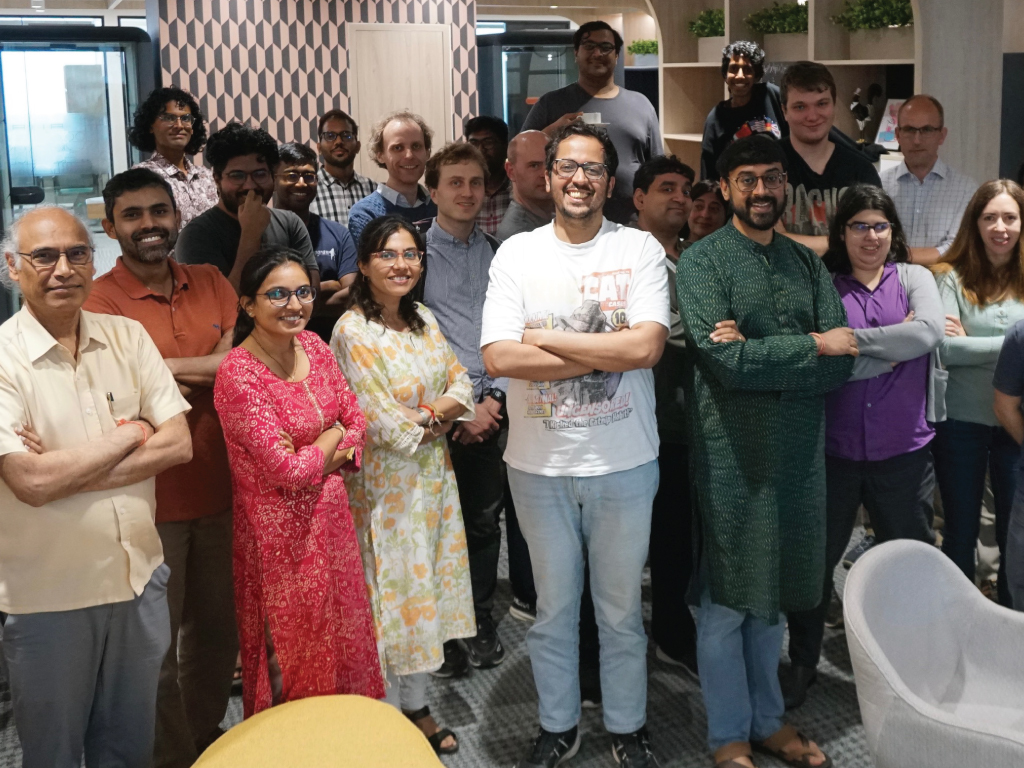
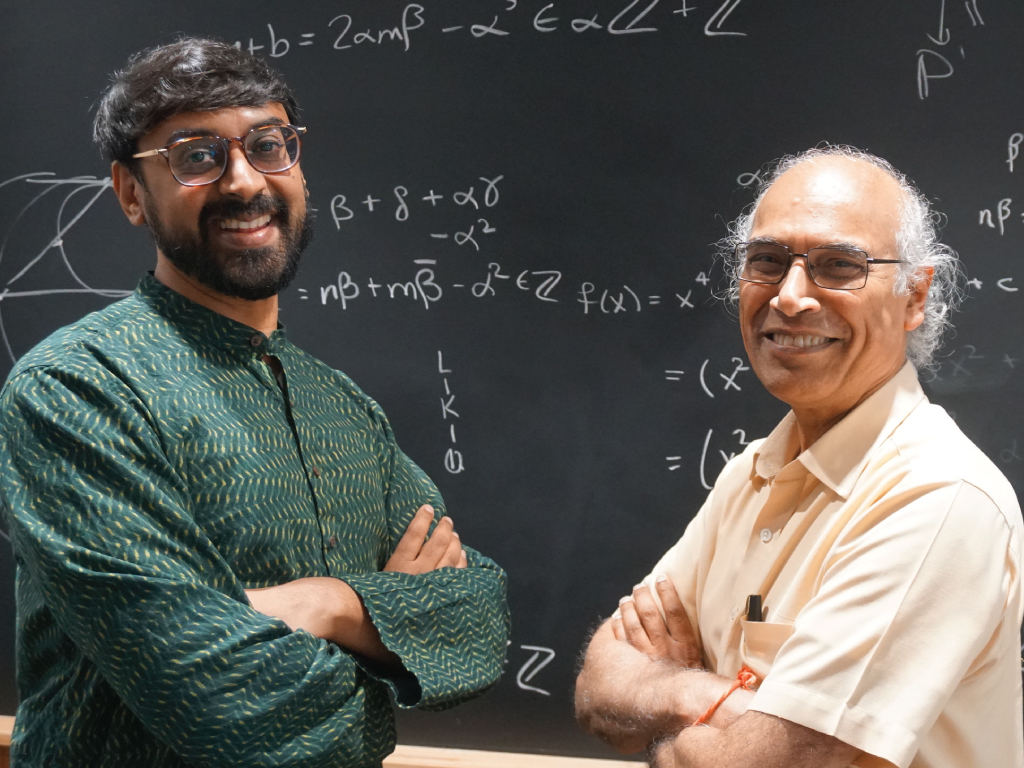
LMSI seeks to build upon India’s rich tradition of mathematical excellence and aims to serve as a beacon of innovation and rigour, attracting the best minds from around the world and fostering a culture of intellectual curiosity and discovery. Hear from some of our founding leaders, Abhishek Lodha, Ashish Kumar Singh and Dr. V Kumar Murty, expressing their optimis

Good Locally Testable Codes | Prof. Alex Lubotzky
This lecture explores locally testable error-correcting codes that achieve constant rate and distance, constructed using Ramanujan Left/Right Cayley square complexes. These codes extend expander codes into higher dimensions and connect to deep ideas from group theory and topology. The talk also introduces the broader landscape of expander graphs and High Dimensional Expanders (HDX), highlighting their growing importance in mathematics and computer science, along with emerging applications and research directions.
A Triple Convolution Sum of the Divisor Function | Prof Ram Murty
We consider triple convolutions of the shifted divisor function and explore a conjecture of Browning through the lens of the theory of arithmetical functions of several variables. We obtain unconditionally upper and lower bounds of the right order of magnitude that supports this conjecture. This is joint work with Biswajyoti Saha and Bikram Misra.
Distribution of Mordell-Weil Ranks, Discriminants and Special Primes | Prof Dinesh Thakur
We describe some results, guesses and heuristics, and discuss some arithmetic statistics questions in both the number field and function field contexts. In more details, we discuss heuristics and evidence on average ranks of various families of elliptic curves over number fields. Then we discuss statistical distribution of primes of rational function field according to their (refined) discriminants, and characterization and statistics of analogs of Wilson and Wieferich primes for function fields.
6 - Torsion in class groups of Quadratic Fields | Prof Frank Thorne
In this lecture, Prof. Frank Thorne examines the distribution and behavior of 6-torsion elements in the class groups of quadratic fields. The discussion focuses on recent quantitative results and the broader implications for conjectures in arithmetic statistics and algebraic number theory.
Arithmetic purity of Strong Approximation and the Geometric Sieve | Prof Zhizhong Huang
(Based on joint work with Y. Cao (Jinan) and R. Zhang (Chongqing).Given a nice variety over a number field that satisfies strong approximation (i.e. rational points are dense in the adelic space), a question first proposed by O. Wittenberg asks whether this property holds true when one removes any Zariski closed subset of codimension at least two. We shall present several qualitative and quantitative positive answers to Wittenberg’s question. Our method combines effective counting results from homogeneous dynamics and various sieve methods, e.g. the affine linear sieve (developed by P. Sarnak et al.) and the geometric sieve (first discovered by T. Ekedahl).
Description of the Strong Approximation Locus Using Brauer–Manin Obstruction for Homogeneous Spaces with Commutative Stabilisers | Haowen Zhang
For a homogeneous space X over a number field k, the BrauerManin obstruction has been used to study strong approximation for X away from a finite set S of places, and known results state that X(k) is dense in the omitting-S projection of the Brauer-Manin set, under certain assumptions.
Local-Global Principle for Nonabelian Second Galois Cohomology over p-adic Function Fields | Nguyên Manh Linh
In the past 30 years, nonabelian second Galois cohomology has been systematically used to study the existence of rational points on homogeneous spaces. We present a local–global principle for neutrality in this cohomology set for simply connected semisimple linear algebraic groups, relative to the overfields of a given semiglobal field such as the function field of a p-adic
Isometries of Lattices with Prescribed Characteristic Polynomials and Brauer-Manin Obstructions | Ting-Yu Lee
Given a reciprocal polynomial f and a lattice L, one asks if there is an isometry of Lwith characteristic polynomial f. In a series of papers of Eva Bayer-Fluckiger and others, they give sufficient and necessary conditions for such an isometry to exist. In this talk, I will approach this problem from a different point of view. I will first construct a homogeneous space of SLn, and showthat each rational point of the homogeneous space corresponds to an isometry of the vector space associated to L. In this setting, the isometries of the lattice itself corresponds to integral points of the homogeneous space. Then we use the integral Brauer-Manin obstructions and strong approximation to solve this problem. This is an on-going project with Y. Cao, Y. Hu, Y. Tian and F. Xu.
On Harish-Chandra’s Notion of an Admissible Distribution | Sandeep Varma
Building on J.-L. Waldspurger’s work, S. DeBacker proved the Hales-Moy-Prasad conjecture under specific hypotheses. This result established an explicit range of validity for Harish-Chandra’s asymptotic character expansion for an irreducible admissible representation of a p-adic reductive group at the identity. Subsequent generalizations by J-L Kim and F. Murnaghan, J. Adler and J. Korman, and L. Spice, extended these results to finer character expansions and regions away from the identity. However, HarishChandra’s original proof was formulated more broadly for the class of "admissible distributions." This talk, based on joint work with J. Adler and E. Sayag, discusses analogues of admissibility tailored to these more explicit expansions, and their generalization to the setting of p-adic symmetric spaces.
On the Artin-Springer Theorem in Schur Index 2 (or a New Proof of a Theorem of Parimala–Sridharan–Suresh) | Anne Quéguiner-Mathieu
Based on a joint work with J.-P. Tignol. A well known theorem, first established by Artin in 1937, and later published by Springer in 1952, states that an anisotropic quadratic form over a field remains anisotropic under odd-degree field extensions. Whether the same property holds for simple linear algebraic groups of type D is a largely open question. In characteristic different from 2, groups of type D are described in terms of hermitian forms with values in a division algebra. When this algebra is a quaternion algebra, the question has a positive answer, due to Parimala Sridharan and Suresh (2001). Their argument reduces the problem to the quadratic form case, and uses the excellence property of function fields of conics, which are generic splitting fields for quaternion algebras. In this talk I will present a new proof of their result, which avoids the excellence argument.
Classical Adjoint Groups and R-Equivalence over Function Fields of p-adic Curves | R. Preeti
Let F be the function field of a smooth geometrically integral curve over a p-adic field. Let G be a classical adjoint group over F. We discuss the triviality of G(F)/R for various groups G and the rationality of the underlying varieties.
Root-Theoretic Bounds on the Essential Dimension of Split Reductive Groups | Danny Ofek
Let G be an algebraic group over a field. The essential dimension of G, denoted ed(G), is the minimal number of algebraically independent parameters required to define an arbitrary G-torsor. Often G-torsors classify a class of algebraic objects, in which case ed(G) measures the complexity of a general member of that class. For example, ed(PGLn) is the number of parameters needed to define a generic division algebra of degree n. We will explain how loop torsors can be used to relate the essential dimension of a split reductive group to the combinatorial complexity of its root system. As an application, we prove new lower bounds on ed(G) for various split simple algebraic groups G. In the case of PGLn, we recover Merkurjev’s celebrated lower bound with a simplified proof.
Arithmetic of Bruhat-Tits Group Schemes over a Semi-Local Dedekind Ring | Anis Zidani
The aim of this talk is to lay the foundations for the cohomological study of Bruhat-Tits group schemes over a semi-local Dedekind ring. In particular, we obtain a simplified proof of the Grothendieck-Serre conjecture in this case and also an analogous result for Bruhat-Tits group schemes of a semisimple simply connected group.